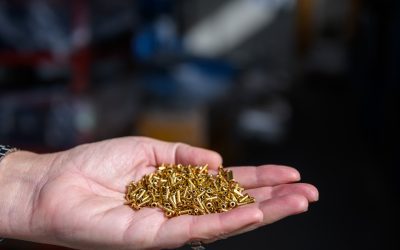
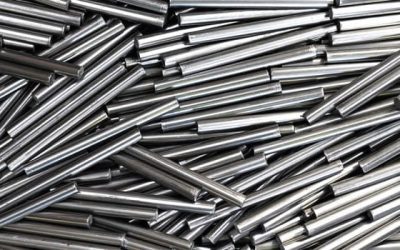
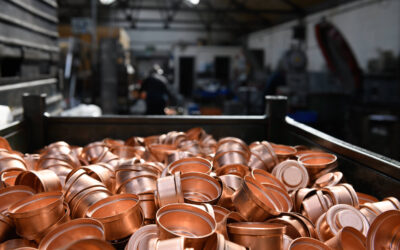
Vibratory polishing is a mechanical metal finishing process used to improve the smoothness, appearance and overall surface quality of components. Parts are placed inside a vibratory finishing machine alongside specially selected polishing media and compounds. The movement of the machine causes the media to continuously interact with the components, gradually refining their surfaces.
The process can be used on a wide variety of metal components and is particularly useful when manufacturers need to achieve consistent results across batches of parts.
Unlike processes primarily designed to remove sharp edges or heavy burrs, vibratory polishing focuses on producing a smoother, brighter and more refined surface.
At Supersheen, we have over 50 years of experience providing professional metal finishing services for manufacturers across a wide range of industries.
How Does Vibratory Polishing Work?
The basic principle behind vibratory polishing is controlled surface interaction.
Components are loaded into a vibratory finishing machine with carefully selected media and a suitable finishing compound. The machine then produces a rapid vibrating motion that causes the media and components to move against one another.
This controlled movement gradually works across the surface of each component.
Depending on the required result, the process can help to:
- Smooth surface imperfections
- Reduce surface roughness
- Brighten metal components
- Produce a more uniform appearance
- Prepare components for subsequent finishing processes
- Improve the overall cosmetic quality of a component
The exact process can be adjusted according to the component material, geometry, starting condition and required finish.
This is one of the reasons professional metal finishing services can be particularly valuable. Rather than applying the same process to every component, the media, compounds and processing time can be selected according to the individual application.
What Media Is Used for Vibratory Polishing?
The choice of vibratory polishing media has a significant influence on the finished result.
Different media can be selected depending on whether the objective is cutting, smoothing, polishing or burnishing.
Typical options can include porcelain media, stainless steel balls or pins and organic materials such as corn cob or walnut shell.
More abrasive media, including certain ceramic products, may be selected where greater material removal is required. For polishing applications, however, less abrasive media is generally used because the objective is to refine and brighten the existing surface rather than aggressively cut into it.
Media is also available in different shapes and sizes.
This is important when processing components with holes, recesses, detailed profiles or other complex features. The correct media needs to interact effectively with the required areas without becoming trapped inside the component.
Which Metals Are Suitable for Vibratory Polishing?
One of the major advantages of vibratory finishing is its versatility.
The process can be adapted for numerous metals, including:
- Stainless steel
- Mild steel
- Aluminium
- Brass
- Copper
- Titanium
- Various engineering alloys
However, the correct process depends heavily on the material.
Aluminium, for example, may require a different media and compound combination from stainless steel. Component geometry, surface condition and the required finish must also be considered.
This is why trial processing can be valuable before committing an entire production batch.
Supersheen offers free sample processing, allowing manufacturers to submit components for testing so that an appropriate finishing programme can be developed before full production begins.
What Components Can Be Vibratory Polished?
Vibratory polishing is particularly useful when manufacturers need to process multiple components while maintaining a consistent finish.
It can be used for everything from relatively simple metal parts to more complex precision-engineered components.
Potential applications include automotive components, aerospace parts, engineering components, fittings, housings, decorative parts and numerous manufactured metal products.
It can also be particularly effective for components where manually polishing every individual item would require considerable time and labour.
By processing components together in a controlled vibratory system, manufacturers can achieve a much more repeatable finish across larger quantities.
What Are the Benefits of Vibratory Polishing?
One of the biggest advantages of vibratory metal finishing is consistency.
Manual finishing can produce excellent results, but the outcome can vary between operators and individual components. Vibratory processing provides much greater control over variables such as processing time, media and compounds.
This makes it particularly useful for production environments.
Another important benefit is efficiency.
Multiple components can be processed simultaneously, helping manufacturers achieve the required surface quality without manually polishing each individual part.
Vibratory polishing can also reach many areas of complex components that may be awkward to polish manually.
Other potential benefits include reduced labour requirements, repeatable surface quality, improved appearance and the ability to process both small and large batches.
What Is the Difference Between Vibratory Polishing and Vibro Deburring?
Although vibratory polishing and vibro deburring can use similar machinery, they have different primary objectives.
Vibro deburring is primarily designed to remove burrs, sharp edges and unwanted surface imperfections created during processes such as machining, cutting, stamping or fabrication.
Vibratory polishing is primarily concerned with surface refinement.
The objective is usually to create a smoother, brighter or more visually attractive finish rather than remove significant burrs or alter edges.
Put simply:
Vibro deburring = remove burrs and sharp edges.
Vibratory polishing = improve smoothness and surface appearance.
The processes can sometimes form different stages of the same overall finishing operation. A component may first require deburring before moving to a finer finishing or polishing process.
For a more detailed explanation, read our guide to the difference between vibratory deburring and polishing.
Is Vibratory Polishing the Same as Ball Burnishing?
Not exactly.
Ball burnishing is another metal finishing technique that can be used to create a high-quality polished surface.
The process typically uses hardened steel media to work against the component surface. Rather than relying primarily on abrasive cutting, burnishing works by smoothing and compacting microscopic surface irregularities.
The result can be a bright, smooth and attractive finish.
Supersheen provides a range of professional metal finishing services, allowing the appropriate process to be selected according to the component and required result.
Vibratory Polishing vs Barrel Polishing
Another process that manufacturers may encounter is barrel polishing.
Barrel polishing involves placing components and finishing media inside a rotating barrel. As the barrel turns, the components and media tumble over one another.
Vibratory polishing instead uses vibration to generate movement between the media and components.
Both methods can be effective, but they produce different movement patterns and may be better suited to different components, batch sizes and finishing requirements.
The best solution therefore depends on factors including the material, component geometry, starting surface and desired final finish.
When Should You Consider Vibratory Polishing?
Vibratory polishing is worth considering whenever a manufacturing process leaves components requiring a smoother, brighter or more consistent finish.
This could be because appearance is important to the finished product or because surface quality has functional benefits.
It may also form part of a wider finishing process before coating, plating, assembly or final inspection.
For manufacturers processing large numbers of components, the repeatability and efficiency of vibratory finishing can make it particularly attractive compared with carrying out extensive manual finishing work.
Find the Right Metal Finishing Process with Supersheen
Choosing the correct finishing process is essential because vibratory polishing, vibro deburring, ball burnishing and barrel polishing are designed to achieve different results.
The material, component shape, initial condition and required finish all need to be considered before deciding on the most suitable method.
With more than 50 years of experience, Supersheen provides specialist metal finishing services for businesses across a wide variety of manufacturing and engineering sectors.
Not sure whether vibratory polishing, vibro deburring or another process is right for your components?
Contact Supersheen to discuss your requirements or arrange free sample processing to see how your components respond to professional metal finishing.