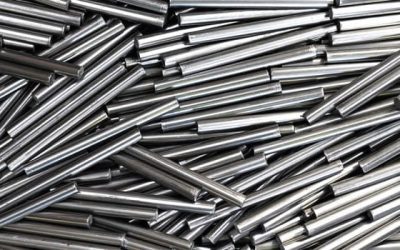
In metal manufacturing and precision engineering, surface finishing plays a crucial role in ensuring components are safe, functional and fit for purpose. Two commonly used finishing processes are vibratory deburring and polishing. While the terms are sometimes used interchangeably, they serve different purposes within the production process and deliver different outcomes.
Understanding the distinction between these processes can help manufacturers choose the right solution, improve component performance and avoid unnecessary costs. This article explains the key differences and how they are often used together.
What is vibratory deburring?
Vibratory deburring is a mass finishing process designed to remove burrs, sharp edges and small surface imperfections that are left behind after machining, stamping, laser cutting or fabrication.
Burrs may be small, but they can cause significant problems. They can create safety risks for operators, interfere with assembly, reduce part accuracy and lead to premature wear. Vibratory deburring focuses on eliminating these issues efficiently and consistently across large volumes of components.
The process involves placing parts into a vibratory machine along with abrasive media and a compound solution. As the machine vibrates, the media moves against the components, gently wearing away unwanted material. Over time, sharp edges are rounded and burrs are removed without damaging the overall geometry of the part.
At Supersheen, vibratory deburring is used across a wide range of industries, including automotive, aerospace, medical and general engineering. The process is particularly effective for complex or high-volume components where manual deburring would be impractical or inconsistent.
The primary objective of vibratory deburring is functionality and safety, not appearance.
What is polishing?
Polishing is a surface finishing process that focuses on improving smoothness and appearance. Unlike deburring, which removes unwanted material, polishing refines the surface to achieve a specified finish, whether that is a smooth matt surface or a bright, reflective sheen.
Polishing can be carried out manually or mechanically, including through vibratory systems using much finer media and compounds than those used for deburring. The intention is not to remove burrs or reshape edges, but to minimise surface roughness and enhance visual quality.
Polishing is often used when components:
-
Need to meet cosmetic or aesthetic requirements
-
Require a smoother surface to reduce friction or contamination
-
Are being prepared for plating, coating or anodising
While vibratory equipment can be used for both deburring and polishing, the media selection, cycle time and compound chemistry are very different.
The key differences explained
Although both processes improve surface condition, the differences are clear when broken down into purpose, timing and results.
Purpose
Vibratory deburring is about removing sharp edges and burrs that can cause problems. Polishing is about refining the surface to improve smoothness or appearance.
Stage in production
Deburring usually takes place soon after machining or forming. Polishing tends to be a later-stage process, often after deburring has already been completed.
Material removal
Deburring removes unwanted material in a controlled way. Polishing removes very little material and focuses on surface refinement rather than reshaping.
Media and compounds
Deburring uses coarser abrasive media designed to break down burrs. Polishing uses finer media and compounds that smooth the surface without altering dimensions.
Outcome
Deburring produces parts that are safe to handle and ready for assembly. Polishing produces parts that look better and feel smoother to the touch.
Do you need both processes?
In many manufacturing applications, vibratory deburring and polishing are complementary rather than competing processes.
For example, a precision-engineered component may first undergo vibratory deburring to remove sharp edges and machining residues. Once the part is safe, dimensionally accurate and functional, it may then be polished to improve surface smoothness or prepare it for further finishing such as coating or plating.
Supersheen’s experience in vibratory finishing allows processes to be tailored to each customer’s requirements. In some cases, a single vibratory process can achieve both deburring and a level of surface refinement. In others, separate stages are used to deliver optimal results.
Why choosing the right process matters
Selecting the correct finishing method has a direct impact on:
-
Product quality and consistency
-
Safety during handling and assembly
-
Component performance and lifespan
-
Downstream processes such as coating or assembly
-
Overall production efficiency and cost
Using polishing when deburring is required may leave dangerous burrs in place. Using aggressive deburring when polishing is needed may remove more material than intended. Understanding the difference ensures the right process is applied at the right stage.
Supersheen’s approach to vibratory finishing
With decades of experience in metal finishing, Supersheen provides professional vibratory deburring services tailored to a wide range of materials and component types. By carefully selecting media, compounds and cycle times, the team ensures burr removal is effective, repeatable and suited to each customer’s needs.
Whether deburring is required as a standalone service or as part of a broader finishing solution, Supersheen’s expertise ensures components meet both functional and quality expectations.
Final thoughts
In simple terms, vibratory deburring removes problems, while polishing enhances quality. Both processes play an important role in modern manufacturing, but they are not the same and should not be treated as such.
By understanding the differences and knowing when each process is required, manufacturers can achieve better results, improve efficiency and ensure their components are safe, reliable and finished to the required standard.